Working principle
Establishment and maintenance of a sterile environment:
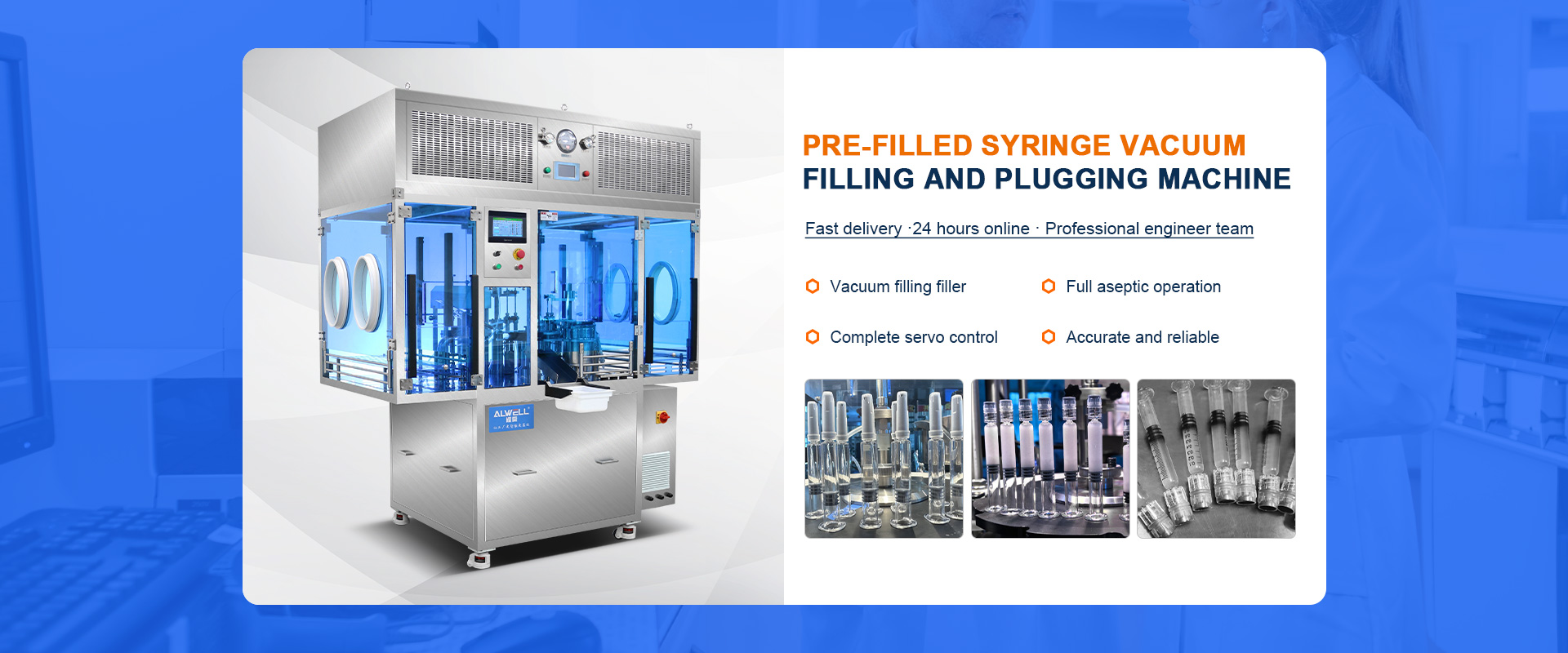
The entire filling area (a critical area) is usually enclosed within an A-class laminar flow hood or an isolator (RABS/Isolator).
High-efficiency filters (HEPA) provide a one-way, vertical clean air flow (ISO 5 level or higher), continuously sweeping the area to prevent the entry of external microorganisms and particles.
The operating area is sterilized online using ultraviolet light disinfectants.
Drug solution supply and measurement:
The sterile-filtered insulin solution is stored in a sterile storage tank or buffer tank upstream of the filling system.
The drug solution is transported through a sterile piping system to the metering unit of the filling machine.
This is the most crucial step:
Ceramic pump filling: The filling accuracy can reach ±1%, reducing material waste.
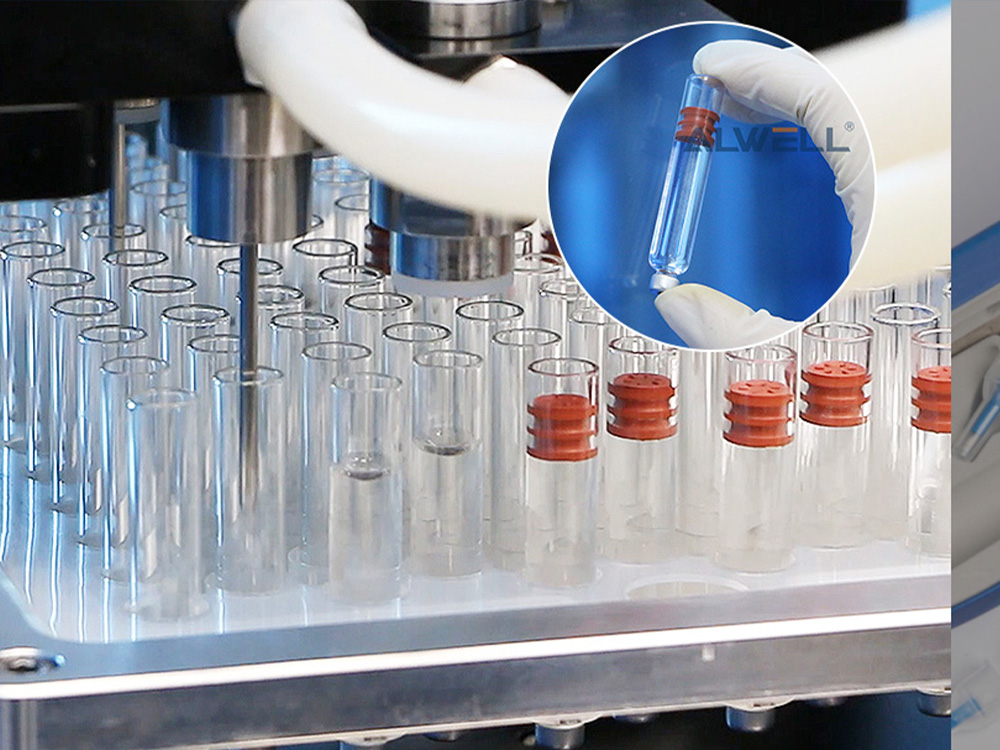
The filling needle (usually made of stainless steel and with a drip-proof design) is precisely lowered to the vicinity of the card-style bottle mouth under the control of the positioning system (avoiding contact with the bottle wall or bottle mouth).
The needle is inserted into the bottle (using non-contact filling, reducing the risk of contamination).
The measurement unit is activated, and the precisely measured insulin solution is injected into the bottle.
After filling, the needle rises with an aspiration action to prevent the drug liquid from dripping and contaminating the bottle mouth or the environment.
Placement of the rubber/elastic body stopper (plunger):
The sterile rubber/elastic body stopper (plunger) is arranged and oriented by a vibration plate and other systems.
The grasping mechanism (vacuum suction head) picks up the stopper and precisely places it above the mouth of the filled cartridge bottle.
The bottle is evacuated and then the plunger head is inserted to prevent bubble formation or spillage of the liquid.
The filled and capped cartridge bottles are then sent out of the filling area.
It usually goes through online inspection systems, such as:
1. Fill volume inspection: Weighing method (high-precision balance) or laser detection method to ensure that the filling volume of each bottle is within the allowable error range (usually requiring ±1% or more strict).
2. Vacuum/top space residual oxygen inspection: Ensure that the gas environment inside the bottle (such as the residual oxygen after inert gas protection) meets the requirements.
3. Cap position inspection: Visual inspection to check if the cap is placed in the correct position and not tilted.
4. Bottle defect inspection: Check if the glass bottle has cracks, foreign objects, etc.
5. Non-conforming products will be automatically removed.
Main features
Extremely high filling accuracy:
Insulin is a highly concentrated and efficient biological product, with extremely strict dosage requirements (typically at the μL level). The equipment must ensure the consistency of the filling volume, and the accuracy is usually required to be within ±1% or even higher. The precision piston pump is the key to achieving this.
Strict aseptic guarantee:
This is the most crucial feature. The entire filling path (storage tank, pipelines, pumps, filling needles) must be sterilized in-line (SIP) or disinfected offline and then assembled aseptically.
The core area of filling must maintain a Class A clean environment (ISO 5 grade).
The isolation technology (RABS/Isolator) is adopted to minimize personnel intervention and contamination risks to the greatest extent.
All components in contact with the medicinal liquid must meet GMP requirements and be easy to clean and sterilize (such as 316L stainless steel, silicone tubes compliant with USP Class VI).
The design of the filling needle must prevent dripping and splashing, and minimize exposure as much as possible.
Low shear force and bubble prevention:
Insulin is a protein and is sensitive to shear force. Excessive shear may lead to denaturation and inactivation. The design of the filling system (especially pumps and valves) should be as gentle as possible to minimize shear during the drug liquid flow process.
The filling process (needle insertion depth, flow rate control, and retraction design) and the process of inserting the cap need to be optimized to minimize bubble formation to the greatest extent.
Inert gas protection (optional but common):
To prevent insulin from oxidizing, inert gases (such as nitrogen) are usually introduced into the cartridge bottles before or during the filling process to replace the air inside and reduce the residual oxygen in the headspace. The filling machine needs to be equipped with an accurate gas replacement device.
High speed and high efficiency:
To meet the demands of large-scale production, modern filling machines are designed with multiple filling heads (such as 8 heads, 12 heads, 16 heads or even more), and the filling speed can reach several hundred bottles per minute.
High levels of automation and intelligence:
Fully automatic operation, continuous production from bottle insertion to bottle ejection.
Integrated PLC/SCADA control system, enabling parameter setting, process monitoring, data recording (in compliance with FDA 21 CFR Part 11 requirements), and alarms.
Integrated multiple online detection systems, enabling real-time quality monitoring and automatic rejection.
Equipped with CIP (Continuous In-Line Cleaning) and SIP (Continuous In-Line Sterilization) functions.
Good compatibility and flexibility:
It needs to adapt to different specifications (capacities) of cartridge bottles (such as 1.5ml, 3ml).
When changing the specifications, key components (such as fixtures, filling needles, measuring cylinders, stopper heads, and capping heads) need to be able to be quickly and conveniently replaced and adjusted (Change Parts), and be easy to clean.
The control system should be able to store the process parameters of different products.
Reliability and stability:
It operates stably for a long continuous period with a low failure rate. Key components (such as pumps and servo motors) require high quality and long lifespan.
It has a complete fault diagnosis and safety interlock function.
Compliant with regulatory requirements:
The design, manufacture, and material selection of the equipment must strictly adhere to the GMP, cGMP, FDA, EMA and other pharmaceutical production quality management standards and relevant regulations.
Provide complete validation support documents (DQ/IQ/OQ/PQ).
Error-proof design and ergonomics:
Prevent errors such as inverted bottle, missing bottle, missing stopper, missing cap, etc.
The operation interface is user-friendly and easy to maintain, reducing the fatigue and error risk of operators.
The design takes into account preventing the breakage of glass bottles (such as the soft landing mechanism).